
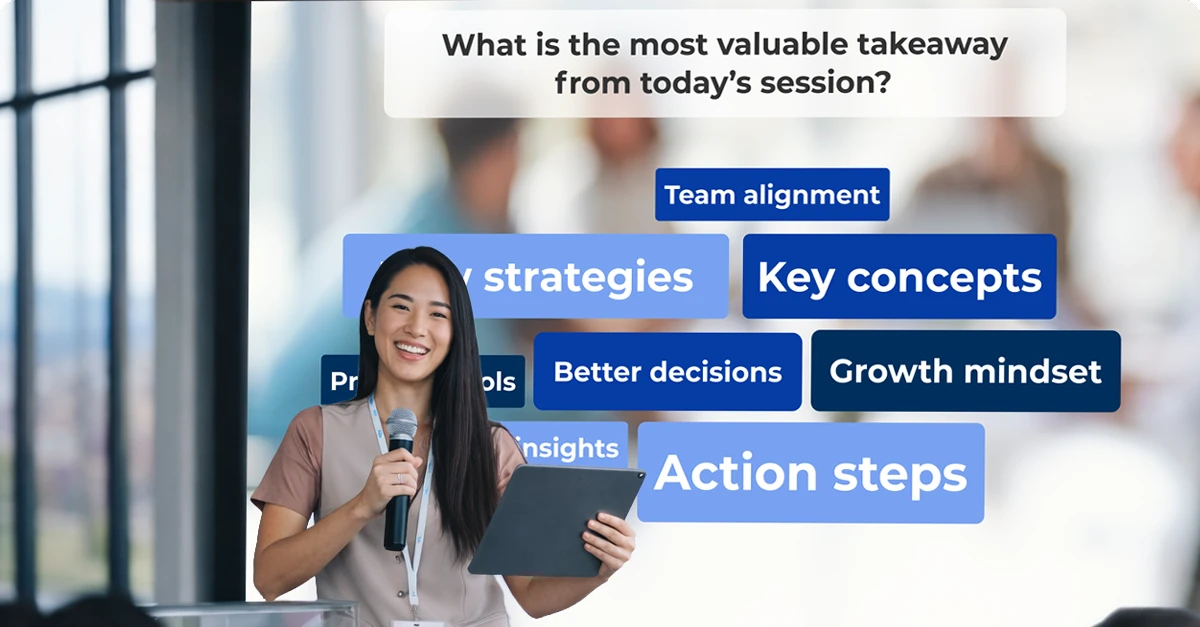
The shift from training hours to real skill-building
- The problem: Most organizations measure training completion, not whether employees’ behaviour actually changes, leaving critical skill gaps open.
- The solution: Anchoring upskilling programs on a small number of capabilities that move KPIs, then building interactive, data-driven learning experiences around them.
- The best tool: Kahoot! 360 helps L&D teams and managers design engaging training programs that close knowledge gaps, drive measurable performance, and give leaders the reporting they need to act.
Employees sit through lengthy courses, check the completion box, and walk away having retained very little. Managers see the numbers on a dashboard and assume the job is done. Then the same skills gaps show up in the next performance review cycle.
The most effective L&D teams are solving this by shifting their focus from training volume to training impact, building programs that anchor on critical skills, make learning interactive, and use data to close the gaps that matter most.
Here’s a 5-step framework for turning your upskilling program into an engine your employees actually use:
Anchor on 3–5 critical skills, not 30 courses
When employees face a catalogue of mandatory courses, they treat all of them as equally important, which means none of them get the attention they deserve.
- Map the capabilities that move the needle: Identify the specific behaviors and skills that directly impact your KPIs and park everything else as secondary.
- Give people a clear reason to invest: Employees who understand why a skill matters to the business and to their own growth show up differently to training.
- Build depth before breadth: Three skills your teams genuinely master will always outperform thirty they’ve technically “completed.”
With Kahoot! 360, you can build focused training programs around your highest-priority capabilities and measure whether those capabilities are actually developing over time.
Works well for: Annual skills roadmaps, performance improvement programs, and capability-building initiatives tied to business outcomes.
Make training interactive, not passive
Employees don’t disengage from training because the content isn’t relevant. They disengage because the format doesn’t give them anything to do.
- Convert static decks into live sessions: Facilitators who run interactive training with polls, scenarios, and live questions see higher engagement and better knowledge retention than those delivering the same content as a slide deck.
- Replace reading with doing: Scenario-based questions that mirror real decisions employees face on the job are far more effective than dense policy documents.
- Make every session feel worth showing up for: When participants know they’ll be asked to contribute, not just listen, attendance and attention both improve.
With Kahoot! 360, trainers can run interactive presentations and meetings that turn passive audiences into active participants, directly from their existing slides, with no rebuilding required.
Works well for: Onboarding, product training, compliance rollouts, and any session where knowledge retention is being tracked.

Reinforce with 5-minute bite-sized learning
A single training session is not enough. Employees forget 70% of what they heard within 24 hours unless they encounter it again.
- Run bite-sized learning after each session: Short mobile assignments immediately following a live session reinforce the key concepts before they fade.
- Keep skills top-of-mind between formal training: Regular micro-learning moments like five minutes on a mobile device, compound into meaningful knowledge retention over time.
- Make reinforcement easy to complete: Employees who can reinforce learning on the go, at their own pace, complete more of it.
With Kahoot! 360, teams can follow up live sessions with self-paced challenges that support collaborative learning and keep critical skills top-of-mind long after the session ends.
Works well for: Ongoing certification, quarterly refreshers, and non-desk employee training.
Use data to close knowledge gaps
Most managers find out their teams missed the mark at the end of the year, when it’s too late to do anything about it.
- Spot which questions people got wrong: Individual and team-level performance data show you exactly where the confusion lies, so you can address it before it becomes a risk.
- Identify the teams falling behind: Completion rates and scores by team or cohort help managers step in with targeted support where it’s needed most.
- Trigger extra coaching where the risk is highest: Data-driven follow-up replaces guesswork with precision, delivering the right intervention for the right person at the right time.
With Kahoot! 360, detailed reports give L&D teams and managers the actionable insights they need to close knowledge gaps and demonstrate real return on training investment.
Works well for: Compliance programs, manager 1:1s, risk assessments, and measuring training ROI.

Show progress, not just completion
Completion rates tell leaders that training happened. They don’t tell leaders whether it worked.
- Report on improvements, not just hours: Tracking performance over time like employee scores, knowledge growth, and behavior change, gives leaders a meaningful picture of what upskilling is actually delivering.
- Make training visible as a performance lever: When leaders see the correlation between engaged training and improved performance, they invest in it differently.
- Give managers the data to have better conversations: A manager who knows which skills gaps exist on their team can have a targeted coaching conversation. One who only sees completion rates cannot.
With Kahoot! 360, L&D leaders can report ROI and skill improvements in a way that helps senior leaders see upskilling as a performance driver, not a compliance obligation.
Works well for: Regulatory reporting, leadership updates, and business cases for L&D investment.
Ready to build an effective upskilling and training program in your company?
Struggling to get employees to complete training programs is a format problem, not a motivation problem. When you anchor on critical skills, make learning interactive, and use data to guide your follow-up, employees show up and the results follow.